
Choosing the right compressed air dryer is essential for controlling moisture, protecting equipment and maintaining reliable performance. The two most common options are refrigerated air dryers and desiccant dryers, but they work differently and are suited to different applications.
If you are unsure whether you need a standard refrigerated dryer or the much lower dew point offered by a desiccant air dryer, understanding how each system works is the best place to start. This guide explains the differences, including how a refrigerated air dryer works, what a desiccant dryer does, and how their dew points affect your choice.
For more information, explore Griffin Air Systems’ range of compressed air dryers or speak to our team about finding the right solution for your compressed air system.
Table of Contents
- What Is a Refrigerated Air Dryer?
- When Should You Use a Refrigerated Air Dryer?
- How Does a Refrigerated Air Dryer Work?
- What Is a Desiccant Dryer?
- When Should You Use a Desiccant Dryer?
- How Does a Desiccant Dryer Work?
- Why Does Regeneration Matter?
- What Is the Difference Between Refrigerated and Desiccant Dryers?
- Refrigerated Dryer Dew Point vs Desiccant Air Dryer Dew Point
- Which Air Dryer Is Right for Your Application?
- Key Takeaways for Refrigerated vs Desiccant Air Dryers
- Frequently Asked Questions
- Choose the Right Air Dryer with Griffin Air Systems
- Related Articles
What Is a Refrigerated Air Dryer?
A refrigerated air dryer removes moisture from compressed air by cooling it until water vapour condenses into liquid water, which can then be separated and drained from the system.
Refrigerated dryers are one of the most widely used types of compressed air dryer because they provide reliable moisture control for many general-purpose applications. They are commonly used in manufacturing, workshops, automotive environments and other applications where extremely low dew points are not required.
A refrigerated dryer is normally installed downstream of the air compressor and before the compressed air enters the distribution system or equipment. Its purpose is to prevent excessive moisture from travelling through pipework and reaching pneumatic tools, machinery and production processes.
For many businesses, a refrigerated air dryer provides the right balance between effective moisture removal, reliability, operating costs and maintenance requirements.
When Should You Use a Refrigerated Air Dryer?
A refrigerated dryer is generally suitable when your compressed air system requires a pressure dew point of around +3°C.
Typical applications include:
- General manufacturing
- Automotive workshops
- Pneumatic tools
- Engineering workshops
- General factory applications
- Production processes without specialist moisture requirements
If your compressed air remains in an environment above the dryer’s pressure dew point, a refrigerated dryer can provide effective protection against condensation.
However, refrigerated dryers have limitations. If your application requires a significantly lower pressure dew point, particularly below 0°C, a desiccant dryer may be more appropriate.
How Does a Refrigerated Air Dryer Work?
A refrigerated dryer cools compressed air so that the water vapour it contains condenses into liquid water, which is then removed before the air leaves the dryer.
The process typically involves several stages.
1. Warm, Moist Compressed Air Enters the Dryer
Compressed air leaving an air compressor can contain a significant amount of water vapour. The amount of moisture depends on factors including the ambient temperature, humidity and operating conditions.
The warm compressed air enters the refrigerated dryer and passes through a heat exchanger.
2. The Air Is Cooled
The dryer uses a refrigeration circuit to reduce the temperature of the compressed air.
As the air becomes colder, its ability to hold water vapour decreases. The excess water vapour therefore condenses into liquid water.
3. Condensed Water Is Separated
The resulting liquid water is separated from the compressed air using a moisture separator and removed through a drain.
This prevents the condensed moisture from continuing through the compressed air system.
4. The Dry Air Leaves the Dryer
The treated compressed air is then typically reheated before leaving the dryer. This helps prevent condensation from forming on the outside of downstream pipework.
The result is compressed air with a substantially reduced moisture content and a pressure dew point typically around +3°C for standard refrigerated dryers.
What Is a Desiccant Dryer?
A desiccant dryer is a compressed air dryer that removes water vapour by passing compressed air through a moisture-attracting material known as a desiccant.
Unlike a refrigerated dryer, which removes moisture primarily through condensation, a desiccant air dryer uses adsorption. Water molecules are captured on the surface of the desiccant material as compressed air passes through it.
Common desiccant materials include activated alumina, silica gel and molecular sieves.
The result is much drier compressed air than a standard refrigerated dryer can typically provide. This makes desiccant dryers suitable for applications where even small amounts of moisture could cause problems.
When Should You Use a Desiccant Dryer?
A desiccant dryer is generally used when an application requires a pressure dew point below 0°C or when exceptionally dry compressed air is needed.
Typical applications can include:
- Pharmaceutical manufacturing
- Food and beverage production
- Electronics manufacturing
- Instrumentation and control systems
- Sensitive manufacturing processes
- Outdoor compressed air systems
- Cold environments where moisture could freeze
- Applications requiring very low pressure dew points
For example, compressed air used to operate pneumatic equipment in a heated workshop may only require a standard refrigerated dryer. However, compressed air supplied through pipework exposed to freezing temperatures may require a much lower dew point to prevent moisture from freezing inside the system.
How Does a Desiccant Dryer Work?
A desiccant dryer removes moisture through a process called adsorption. Compressed air passes through a bed of desiccant material, which attracts and holds water vapour on its surface.
Most industrial regenerative desiccant dryers use two vessels or towers.
The Drying Cycle
One tower is used to dry the compressed air. Moist air enters the vessel and passes through the desiccant material, where water vapour is adsorbed.
The resulting dry air then leaves the dryer and continues into the compressed air system.
The Regeneration Cycle
Desiccant material can only hold a certain amount of moisture before it becomes saturated. It therefore needs to be regenerated.
While one tower is drying the compressed air, the second tower can be regenerated to remove the moisture that has accumulated in its desiccant material.
Once regeneration is complete, the towers switch roles.
This alternating process allows regenerative desiccant dryers to provide a continuous supply of dry compressed air.
Why Does Regeneration Matter?
The regeneration method affects the energy consumption and operating costs of a desiccant dryer.
Different systems use different approaches, including heatless, heated and blower-assisted regeneration. The most appropriate option depends on factors such as compressed air demand, required dew point and the size of the installation.
This is one reason why a desiccant dryer can have higher running costs than a refrigerated dryer, despite providing significantly drier compressed air.
What Is the Difference Between Refrigerated and Desiccant Dryers?
The main difference between refrigerated and desiccant dryers is the level of moisture removal they provide.
A refrigerated dryer removes moisture by cooling compressed air until water condenses. A desiccant dryer removes water vapour through adsorption, allowing it to achieve much lower pressure dew points.
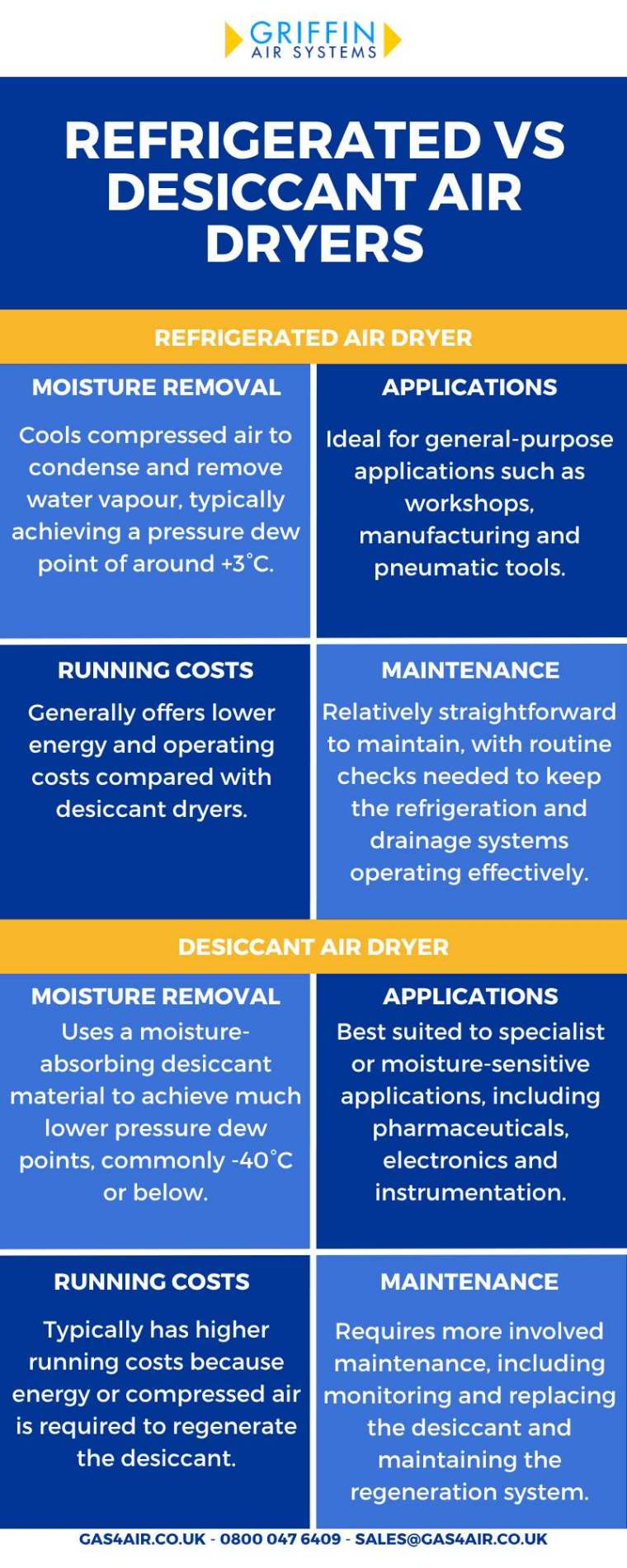
| Feature | Refrigerated Dryer | Desiccant Dryer |
|---|---|---|
| Drying method | Cooling and condensation | Adsorption |
| Typical pressure dew point | Around +3°C | Commonly -40°C or lower |
| Best suited to | General-purpose applications | Specialist and moisture-sensitive applications |
| Cold environments | Limited | Well suited |
| Initial cost | Generally lower | Generally higher |
| Running costs | Generally lower | Generally higher |
| Maintenance | Relatively straightforward | More involved |
| Typical applications | Workshops, manufacturing, pneumatic tools | Pharmaceuticals, electronics, instrumentation |
Neither type is inherently better than the other. The right choice depends on the pressure dew point your application requires.
Refrigerated Dryer Dew Point vs Desiccant Air Dryer Dew Point
Dew point is one of the most important factors when choosing between refrigerated and desiccant dryers.
The pressure dew point is the temperature at which water vapour in compressed air will begin to condense at a given pressure. A lower pressure dew point therefore means the compressed air contains less moisture.
What Is the Refrigerated Dryer Dew Point?
A standard refrigerated dryer typically provides a pressure dew point of around +3°C.
This is suitable for many general-purpose compressed air applications because the air remains above the temperature at which significant condensation would occur under normal operating conditions.
However, a +3°C pressure dew point is not suitable for every environment.
If compressed air pipework is exposed to temperatures below this point, moisture can potentially condense within the system. In particularly cold conditions, this moisture can freeze.
What Is the Desiccant Air Dryer Dew Point?
A desiccant air dryer dew point can be significantly lower than that of a refrigerated dryer.
Depending on the dryer design, desiccant systems can commonly achieve pressure dew points of -40°C or below, with some systems capable of reaching even lower levels.
This makes them suitable where compressed air needs to remain extremely dry, including applications where freezing, contamination or moisture-related equipment problems are a concern.
The key point is that you should not automatically choose a desiccant dryer simply because it produces a lower dew point. If your application only requires a +3°C pressure dew point, the additional cost and energy requirements of desiccant drying may not provide a worthwhile benefit.
Which Air Dryer Is Right for Your Application?
The best dryer depends on your application, operating environment and required air quality.
Choose a Refrigerated Dryer If:
A refrigerated dryer is generally the better choice if you need reliable moisture removal for a standard compressed air application.
It may be suitable if:
- Your required pressure dew point is around +3°C.
- Your compressed air system operates in a temperature-controlled environment.
- You are running pneumatic tools or general manufacturing equipment.
- You want relatively low operating costs.
- Your application does not require exceptionally dry air.
For many workshops and general industrial applications, a refrigerated dryer provides sufficient moisture control without the additional complexity of a desiccant system.
Choose a Desiccant Dryer If:
A desiccant dryer is more appropriate when your application requires a much lower pressure dew point.
It may be suitable if:
- Your process requires very dry compressed air.
- Pipework or equipment operates in freezing conditions.
- Moisture could damage sensitive products or equipment.
- You require a pressure dew point below 0°C.
- Your application has particularly stringent air-quality requirements.
For example, a pharmaceutical manufacturing process may have significantly greater moisture-control requirements than a workshop using compressed air for pneumatic tools.
Consider the Operating Environment
Temperature is particularly important when selecting a dryer.
If compressed air travels through pipework in an unheated building or outdoors, the temperature of the air and surrounding environment needs to be considered alongside the dryer’s pressure dew point.
A refrigerated dryer may be perfectly adequate inside a heated factory but unsuitable for an installation where pipework is exposed to sub-zero temperatures.
Consider Your Air Quality Requirements
Your industry and production process can also determine the level of drying required.
Applications involving sensitive products, instrumentation or critical processes may require exceptionally dry air. In these situations, a desiccant dryer can provide the additional moisture control required.
It is important to consider the complete compressed air quality requirement rather than choosing a dryer based solely on its capacity.
Consider Running Costs
Refrigerated dryers generally have lower energy and operating costs than desiccant systems.
Desiccant dryers require additional energy or compressed air for regeneration, depending on the technology used. However, this additional cost may be justified if the application genuinely requires ultra-dry compressed air.
The cheapest dryer to purchase is therefore not necessarily the cheapest option to operate, while the most powerful dryer is not necessarily the most appropriate.
Key Takeaways for Refrigerated vs Desiccant Air Dryers
- Refrigerated and desiccant dryers are designed for different levels of moisture control.
- A refrigerated dryer typically provides a pressure dew point of around +3°C.
- A desiccant dryer can provide much lower dew points, commonly around -40°C or below.
- Refrigerated dryers are generally suitable for workshops, manufacturing and other general-purpose applications.
- Desiccant dryers are better suited to specialist applications requiring exceptionally dry compressed air.
- Consider your required dew point, operating environment, airflow, application and running costs before choosing a dryer.
- A lower dew point is not automatically better if your application does not require it.
- Choosing the correct dryer can help protect pipework, equipment, products and production processes from moisture-related problems.
Frequently Asked Questions
What does an air compressor dryer do?
An air compressor dryer removes moisture from compressed air before it reaches your tools, equipment or production processes. Removing excess moisture helps reduce corrosion, protect pneumatic equipment and prevent moisture-related problems with products or processes.
How do I choose the right air dryer for my compressor?
Choose an air dryer based on your required pressure dew point, compressed air flow rate, operating environment and application. A refrigerated dryer is usually suitable for general-purpose applications, while a desiccant dryer may be needed where a much lower dew point is required.
Do I need an air dryer for my compressor?
Most compressed air systems can benefit from an air dryer because compression increases the concentration of moisture in the air. Without adequate drying, this moisture can cause corrosion, damage equipment and affect production processes. The type of dryer you need depends on how dry your compressed air needs to be.
Choose the Right Air Dryer with Griffin Air Systems
Choosing between a refrigerated and desiccant dryer ultimately comes down to one question: how dry does your compressed air actually need to be?
For many general-purpose applications, a refrigerated dryer provides reliable moisture control at a relatively low operating cost. Where your process requires exceptionally dry air, a desiccant dryer can provide the much lower pressure dew point needed to protect equipment and maintain reliable operation.
At Griffin Air Systems, we can help you identify the most appropriate compressed air drying solution for your application. Explore our range of compressed air dryers or contact Griffin Air Systems for advice on selecting the right equipment for your system.