Water in compressed air systems is a common issue across UK workshops and industrial environments, often showing up as reduced performance, equipment wear or visible condensation in pipework. The root cause is usually compressed air moisture, which forms naturally during the compression process as the relative humidity of compressed air rises and then condenses.
Left unmanaged, water in compressed air lines can lead to corrosion, product contamination and costly downtime, making effective moisture removal from air essential for reliable operation. Understanding where this moisture comes from and how to control it is the first step towards a more efficient system.
Table of Contents:
- How Is Water Created In A Compressed Air System?
- What Causes Water In Compressed Air Lines?
- How To Remove Water From Compressed Air Systems?
- How To Prevent Compressed Air Moisture Build-Up?
How Is Water Created In A Compressed Air System?
Water in a compressed air system is created as a natural result of how atmospheric air behaves when it is compressed and then cooled. The air drawn into a compressor always contains water vapour, even if it feels dry, and this moisture becomes more problematic once pressure and temperature begin to change within the system.
Moisture Is Always Present In Ambient Air
All atmospheric air contains a level of water vapour, and this is the starting point for any compressed air system. In the UK, humidity levels are often moderate to high, meaning more moisture is introduced into the system from the outset.
This moisture content varies depending on weather conditions and location, but it is never completely absent. Even on colder or drier days, there is still enough water vapour in the air to contribute to condensation further down the line once the air is compressed.
Compression Increases Moisture Concentration And Relative Humidity
When air is compressed, its volume is reduced significantly, but the amount of water vapour it contains stays the same. This means the moisture becomes much more concentrated within a smaller space.
As a result, the relative humidity of compressed air rises rapidly, often pushing the air close to or at saturation point. At this stage, the air is holding as much moisture as it possibly can, meaning it becomes highly sensitive to any further changes in temperature or pressure.
- Air volume decreases while moisture content remains constant
- Relative humidity increases sharply during compression
- Air quickly approaches saturation point under pressure
Cooling Causes Condensation Inside The System
After leaving the compressor, the air is typically at a high temperature. As it travels through receivers, pipework and downstream equipment, it gradually cools. This cooling process is where water in compressed air lines begins to form.
Cooler air cannot hold the same amount of moisture as warm air, so once the temperature drops, excess water vapour is forced out of suspension and turns into liquid. This condensation then collects within the system, often appearing in pipework, filters and air receivers.
Why This Happens In Every Compressed Air System
This process is unavoidable because it is driven by basic physical principles rather than equipment performance. Every compressed air system will generate some level of moisture simply through compression and cooling.
The key issue is not whether water is created, but how effectively it is managed. Without proper control, this naturally occurring moisture can build up and begin to impact efficiency, equipment lifespan and air quality.
What Causes Water In Compressed Air Lines?
While water is created naturally during the compression process, certain system conditions and design factors determine how much of it actually builds up in pipework and becomes a problem. In most cases, excess water in compressed air lines is not caused by a single fault, but by a combination of environmental conditions, equipment choices and how the system is managed over time.
Understanding these causes is important because it helps identify whether the issue is expected behaviour or a sign that the system needs improving or upgrading.
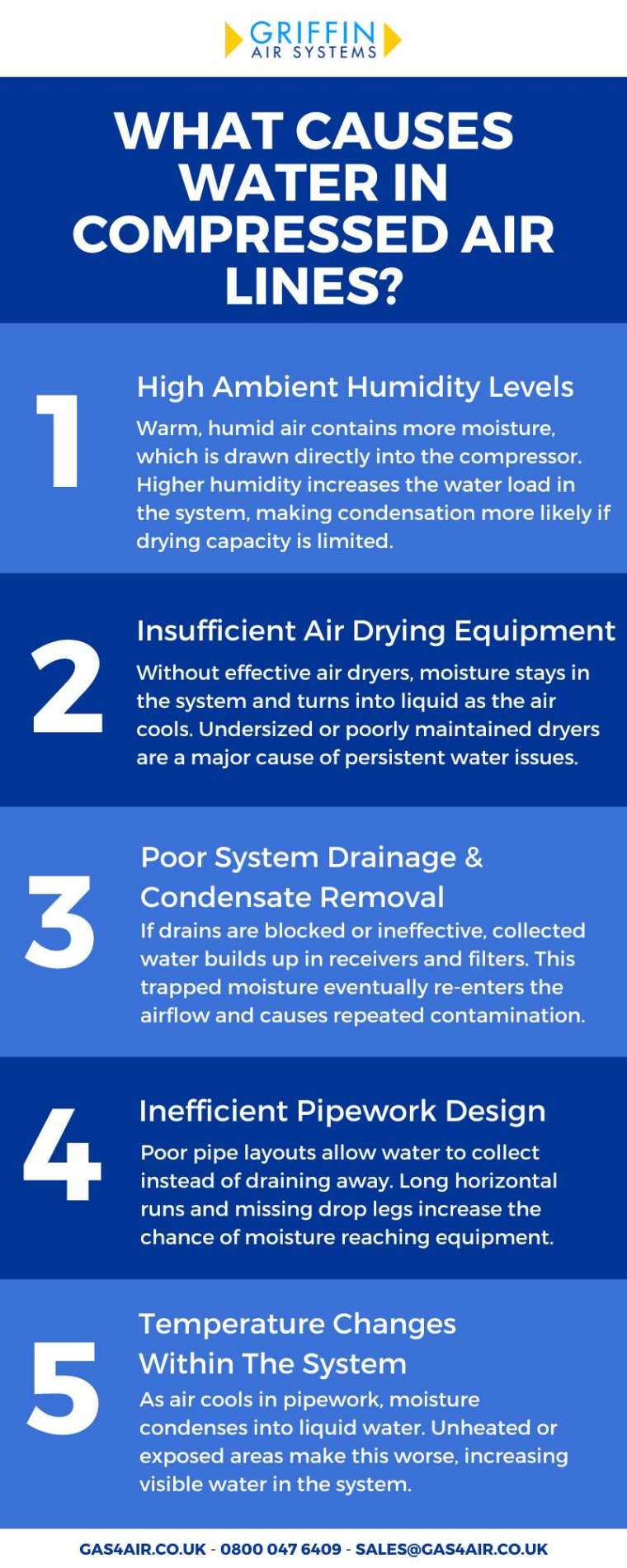
High Ambient Humidity Levels
One of the most common causes of excessive moisture in a compressed air system is the level of humidity in the surrounding environment. Since compressors draw in atmospheric air, any increase in humidity directly increases the amount of water vapour entering the system.
In environments where humidity is consistently high, the system has to work harder to manage the additional moisture load. This often results in more condensation forming further down the line, particularly if drying capacity is limited.
Insufficient Air Drying Equipment
Without effective air drying equipment, moisture will remain in the system and continue to accumulate as the air cools. Many compressed air systems rely too heavily on basic separation or have undersized drying capacity for the demand placed on them.
When air dryers are missing, poorly maintained or not correctly specified, water removal becomes inefficient, leading to visible moisture in pipework and at point of use.
Poor System Drainage And Condensate Removal
Even when moisture is successfully separated from the air, it still needs to be removed from the system. If condensate drains are blocked, manually operated or not regularly maintained, water can build up in low points such as receivers, filters and pipework.
Over time, this trapped moisture is carried further through the system, eventually appearing in compressed air lines and equipment.
Inefficient Pipework Design
The layout of the compressed air system plays a major role in how moisture behaves. Poorly designed pipework can encourage water to collect in certain areas rather than being directed towards drainage points.
Common design issues include long horizontal runs, lack of fall in pipework and missing drop legs. These allow water to pool and re-enter the airflow, increasing the likelihood of moisture reaching downstream equipment.
Temperature Changes Within The System
As compressed air travels through the system, it naturally cools. However, rapid or uneven temperature changes can increase the rate of condensation.
This is particularly common when pipework passes through unheated areas such as external walls, plant rooms or exposed sections of building infrastructure. These temperature drops encourage additional moisture to form inside the lines.
When These Causes Combine
In many real-world systems, these factors do not occur in isolation. Instead, high humidity, limited drying capacity, poor drainage and suboptimal design often combine, significantly increasing the amount of water present in compressed air lines.
This is why moisture issues often worsen over time rather than appearing suddenly, making early identification and system optimisation essential.
How To Remove Water From Compressed Air Systems
Once water has entered a compressed air system, it needs to be actively removed to prevent it from circulating through pipework and reaching tools, machinery and end-use applications. Effective moisture removal from air is not achieved through a single solution, but through a combination of equipment working together to separate, collect and discharge water before it causes issues downstream.
The most reliable systems use staged treatment, starting at the point of compression and continuing through to point-of-use filtration.
Aftercoolers And Air Receivers
Aftercoolers are often the first stage in moisture control. They reduce the temperature of compressed air immediately after it leaves the compressor, which forces a large portion of water vapour to condense early in the process where it can be more easily removed.
Air receivers also play an important role by allowing air to cool further and giving condensed water a place to collect before it moves into the wider system.
- Aftercoolers reduce air temperature and encourage early condensation
- Air receivers act as a buffer and collection point for water
- Both help reduce the moisture load carried into pipework
Air Dryers For Moisture Removal
Air dryers are essential for controlling the amount of water remaining in compressed air after initial separation. They are designed specifically to remove moisture that would otherwise remain in the system as vapour and later condense.
Different types of dryers are used depending on the level of dryness required and the application.
- Refrigerated dryers remove moisture by cooling air to condense water vapour
- Desiccant dryers use absorbent materials to achieve very low moisture levels
- Dryer selection depends on air quality requirements and system demand
Filtration Systems For Fine Moisture Control
Even after drying, small amounts of moisture can remain in the air. Filtration systems help capture these remaining water droplets along with oil and particulates, improving overall air quality.
Coalescing filters are commonly used to remove fine mist and droplets that pass through earlier stages of treatment, particularly in more sensitive applications.
Automatic Drainage Systems
All moisture removed from compressed air must be safely discharged from the system. Automatic drain valves are used to remove collected condensate from receivers, filters and separators without manual intervention.
This ensures that water does not build up in low points of the system, where it could otherwise re-enter the airflow and continue circulating.
- Prevents standing water in system components
- Reduces maintenance requirements
- Improves reliability and consistency of moisture removal
Why A Combined Approach Works Best
No single component can fully eliminate water in compressed air lines on its own. Instead, effective moisture control relies on each stage of treatment working together, from initial cooling and separation through to final filtration and drainage.
When properly designed and maintained, this layered approach significantly reduces the risk of moisture reaching downstream equipment and helps maintain consistent system performance.
How To Prevent Compressed Air Moisture Build-Up
Preventing water in compressed air systems before it begins is far more effective than dealing with it once it has already entered the pipework. When moisture is allowed to circulate, it gradually reduces efficiency, increases wear on equipment and can lead to ongoing reliability issues. The most effective approach is to control moisture from the point of compression and manage it consistently throughout the system.
A structured approach helps ensure nothing is missed and that moisture is controlled at every stage.
Step-By-Step Prevention Approach
- Assess Your Air Demand And Moisture Risk – Start by understanding how much air your system uses and how sensitive your application is to moisture. Higher demand systems or moisture-sensitive processes will require more advanced drying and filtration.
- Install The Correct Air Drying System – Ensure your system includes the right type of dryer for your application. Refrigerated dryers are typically suitable for general use, while desiccant dryers are required where very low moisture levels are needed.
- Improve Initial Moisture Separation – Use aftercoolers and air receivers to remove bulk moisture as early as possible. This reduces the load placed on downstream drying equipment and helps prevent saturation further along the system.
- Review Pipework Design And Layout – Check how air is distributed through the system. Poorly designed pipework can trap water and reintroduce it into the airflow. Where possible, ensure pipework is sloped and includes drop legs to direct moisture towards drain points.
- Ensure Effective Drainage Is In Place – All collected condensate must be removed efficiently. Install and maintain automatic drain valves on receivers, filters and separators to prevent water build-up in low points.
- Monitor And Maintain System Performance – Regular servicing helps ensure dryers, filters and drains continue to operate effectively. Monitoring for early signs of moisture build-up can prevent larger system issues developing over time.
Why Prevention Matters Long Term
Once water in compressed air lines becomes a recurring issue, it often indicates that the system is working harder than it should be or that key components are no longer performing effectively. Taking a preventative approach reduces downtime, protects equipment and helps maintain consistent air quality across the entire system.
Key Takeaways For Water In Compressed Air Systems
- Water in compressed air systems is unavoidable because atmospheric air always contains moisture that becomes concentrated during compression.
- The relative humidity of compressed air increases as pressure rises, which makes the air more likely to reach saturation and form condensation.
- Cooling within pipework, receivers and downstream equipment is the main trigger for visible water in compressed air lines.
- Moisture issues are usually caused by a combination of factors including high ambient humidity, insufficient drying, poor drainage and inefficient system design.
- Effective moisture removal from air requires a staged approach using aftercoolers, air receivers, air dryers, filtration and reliable drainage systems.
- No single solution eliminates water on its own, so performance depends on how well each component works together as a complete system.
- Preventing water build-up is more effective than reacting to it and relies on correct system design, proper equipment selection and ongoing maintenance.
- Persistent moisture issues can indicate underlying system inefficiencies that may require professional assessment or upgrades.
FAQs
What Causes Water In Compressed Air Lines?
Water in compressed air lines is caused by moisture in atmospheric air condensing as the air is compressed and then cooled within the system. As air pressure increases, moisture becomes concentrated and the relative humidity rises, which leads to condensation when temperatures drop in pipework and equipment.
This is a natural process in all compressed air systems, but it becomes more noticeable when drying, filtration or drainage systems are insufficient or not properly maintained.
How To Keep Water Out Of Air Compressor Lines?
The best way to keep water out of air compressor lines is to combine effective air drying, proper system design and regular maintenance. Moisture cannot be fully eliminated at source, so it must be controlled at multiple stages of the system.
This typically includes installing the correct air dryer, ensuring condensate is removed efficiently through automatic drains, and designing pipework so that water is directed away from airflow and towards drainage points.
Why Am I Getting So Much Water In My Air Compressor?
Excess water in an air compressor system usually indicates that moisture is not being effectively removed or managed. This is often caused by high ambient humidity, undersized or faulty air dryers, blocked drains, or poor pipework design that allows condensation to build up.
If the amount of water has increased over time, it can also suggest that system components are wearing out or no longer operating efficiently, leading to reduced moisture control.
How Often Should I Drain The Water Out Of My Air Compressor?
Water should ideally be drained continuously using an automatic drain system to prevent build-up in receivers and low points of the system. If manual draining is used, it should be done at least daily, and more frequently in high-demand or high-humidity environments.
Regular draining is essential because standing water can quickly re-enter the airflow and contribute to corrosion and equipment damage.
What Component Removes Moisture From Compressed Air?
Moisture is removed from compressed air using a combination of components rather than a single device. Air dryers are the primary solution, with refrigerated dryers used for general applications and desiccant dryers used where very low moisture levels are required.
In addition, aftercoolers, air receivers, and coalescing filters all play important roles in reducing moisture levels before air reaches point-of-use equipment.
Keep Your Compressed Air System Dry & Efficient With Griffin Air Systems
Water in compressed air systems is a natural by-product of the compression process, but when it is not properly controlled it can quickly lead to performance issues, corrosion and costly downtime. As we’ve explored, moisture forms when atmospheric air is compressed and cooled, making effective drying, filtration and drainage essential for reliable system operation.
The most effective way to manage water in compressed air lines is through a properly designed system that combines the right equipment with ongoing maintenance. From air dryers and aftercoolers to pipework design and condensate removal, each stage plays a key role in controlling compressed air moisture.
If you’re dealing with persistent moisture issues or want to improve the efficiency of your system, Griffin Air Systems can provide expert support, from system design and servicing through to air quality solutions tailored to your setup.