Choosing the right industrial air compressor can have a significant impact on production efficiency, maintenance requirements, operating costs and the quality of your finished products. One of the most important decisions is whether to choose an oil-free vs oil air compressor or an oil-lubricated model.
The right option depends on how the compressed air will be used. While an oil-lubricated air compressor can be a practical choice for many industrial applications, an oil-free compressor may be essential where air purity is critical.
In this guide, Griffin Air Systems compares oil vs oil-free compressors, explaining how they work, their advantages and disadvantages, and which applications each type is best suited to. If you’re considering a new compressed air system, understanding the difference can help you make a more informed decision.
Table of Contents
- What Is the Difference Between Oil-Free and Oil-Lubricated Air Compressors?
- How Do Oil-Free Air Compressors Work?
- What Are Oil-Lubricated Air Compressors?
- Oil-Free vs Oil-Lubricated Air Compressors: Key Differences
- Are Oil-Free Compressors Better for Industrial Applications?
- When Should You Choose an Oil-Free Air Compressor?
- When Is an Oil-Lubricated Air Compressor the Better Choice?
- How Do Oil-Free and Oil-Lubricated Compressors Compare for Maintenance?
- Which Compressor Is More Cost-Effective?
- Key Takeaways for Oil-Free vs Oil-Lubricated Air Compressors
- Frequently Asked Questions
- Choose the Right Industrial Air Compressor with Griffin Air Systems
What Is the Difference Between Oil-Free and Oil-Lubricated Air Compressors?
The main difference between oil-free and oil-lubricated air compressors is whether oil is used within the compression process to lubricate and cool internal components.
An oil-lubricated air compressor uses oil within the compression chamber and associated components. The oil helps reduce friction, manage heat and protect internal parts, while filtration and separation systems help prevent oil from entering the compressed air supply.
An oil-free compressor does not use oil in the compression chamber. Instead, it uses alternative methods and materials to minimise friction and manage heat during compression.
The choice between oil free vs oil air compressor technology therefore largely comes down to the required air purity, application, operating environment and total cost of ownership.
How Do Oil-Free Air Compressors Work?
Oil-free compressors produce compressed air without introducing lubricating oil into the compression chamber. Depending on the compressor design, specialised coatings, materials, seals or other technologies are used to allow the compression process to take place without conventional lubrication.
The primary advantage is that the compressed air can be produced without oil contamination from the compression process.
What are oil-free compressors used for?
Oil-free compressors are commonly considered for applications where even small amounts of oil contamination could affect products, processes or equipment.
Typical industries include:
- Food and beverage manufacturing
- Pharmaceutical production
- Medical and healthcare applications
- Electronics manufacturing
- Chemical processing
- Laboratories
- Certain automotive and specialist manufacturing applications
For these environments, air quality can be a critical consideration rather than simply an operational preference.
What Are Oil-Lubricated Air Compressors?
Oil-lubricated compressors use oil to lubricate moving components within the compression system. The oil helps reduce friction, dissipate heat and protect components from wear.
Modern oil-lubricated compressors are designed with filtration and separation systems to minimise the amount of oil carried over into the compressed air.
They are widely used across industrial and commercial environments where extremely high levels of air purity are not required.
What are oil-lubricated compressors used for?
Common applications include:
- General manufacturing
- Engineering workshops
- Automotive workshops
- Construction
- Pneumatic tools
- Industrial machinery
- General factory processes
For many applications, an oil-lubricated compressor can provide a reliable and cost-effective source of compressed air.
Oil-Free vs Oil-Lubricated Air Compressors: Key Differences
When comparing an oil vs oil-free compressor, it is important to consider more than whether oil is present. Air purity, maintenance, energy efficiency, purchase price and the intended application can all influence the best choice.
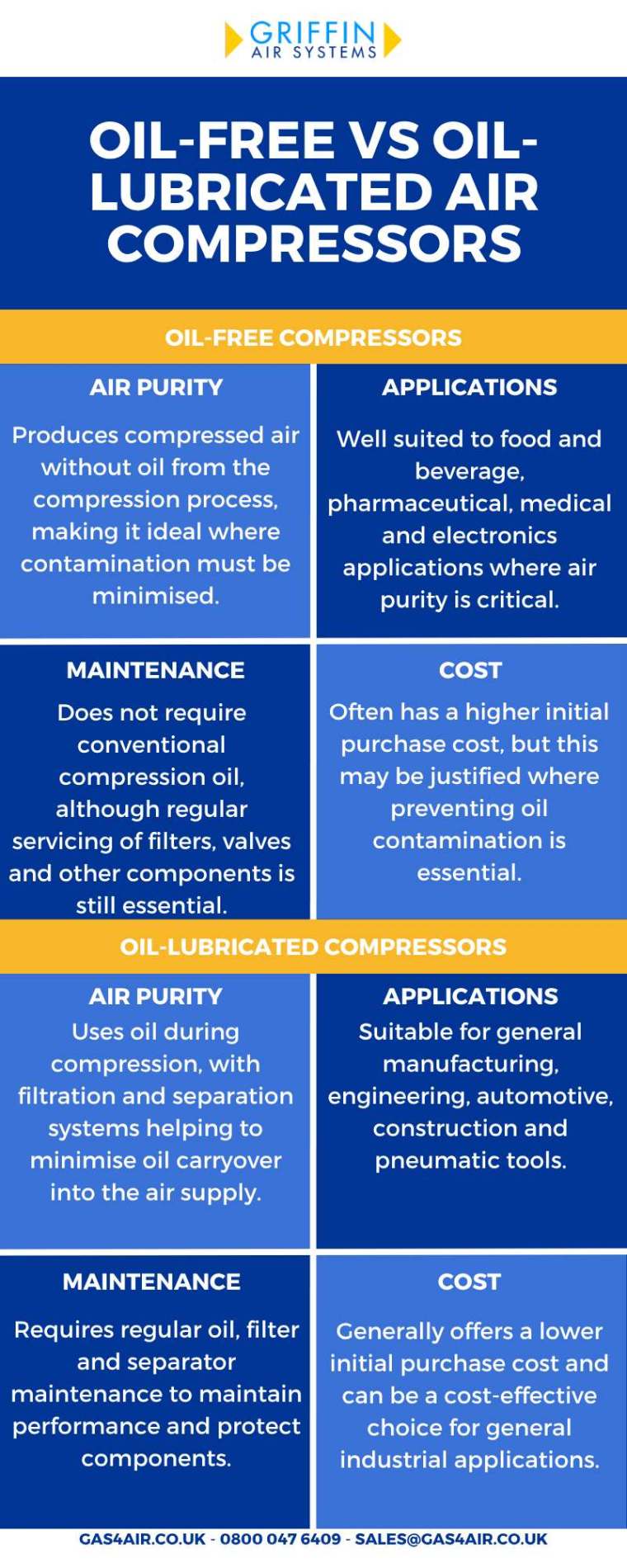
| Factor | Oil-Free Compressor | Oil-Lubricated Compressor |
|---|---|---|
| Oil in compression chamber | No | Yes |
| Air purity | Suitable for applications requiring high air purity | Suitable where small levels of oil carryover can be managed |
| Typical applications | Food, pharmaceutical, medical and specialist manufacturing | General industrial and commercial applications |
| Initial investment | Often higher | Often lower |
| Lubrication requirements | Does not use conventional compression oil | Requires oil and associated maintenance |
| Maintenance | Still requires regular servicing | Requires regular oil, filter and separator maintenance |
| Oil contamination risk | Very low from the compression process | Requires filtration and separation |
| Suitability | Best where air purity is critical | Best for many general-purpose applications |
Neither option is automatically better. The most appropriate compressor depends on the specific requirements of your business.
Are Oil-Free Compressors Better for Industrial Applications?
Oil-free compressors can be better for industrial applications where compressed air purity is critical. However, that does not mean they are universally better than oil-lubricated compressors.
The key question is not simply “are oil-free compressors better?” but rather “which compressor is better for my application?”
If your manufacturing process cannot tolerate oil contamination, an oil-free compressor may be the appropriate solution. If your application is less sensitive to oil contamination, an oil-lubricated compressor may provide a more economical and practical option.
What are the advantages of oil-free compressors?
Oil-free compressors can offer several benefits, including:
- Reduced risk of oil contamination from the compression process
- Suitable for sensitive manufacturing environments
- Appropriate for industries with stringent air purity requirements
- No need for conventional compression oil
- Can help businesses meet specific air quality requirements when correctly specified and maintained
However, oil-free technology does not mean the complete compressed air system can be ignored. Air treatment, filtration, pipework and maintenance can all influence the quality of air delivered to the point of use.
When Should You Choose an Oil-Free Air Compressor?
An oil-free compressor should be considered when air purity is a critical requirement of the production process.
For example, food and beverage manufacturers may need to minimise the risk of oil contamination reaching products or packaging. Pharmaceutical and medical applications can have similarly strict requirements.
Industries that may benefit from oil-free compression
Oil-free technology can be particularly relevant to:
- Food and beverage: Compressed air may come into direct or indirect contact with food products, packaging or production equipment.
- Pharmaceuticals: Manufacturing processes can have stringent requirements for contamination control and air quality.
- Healthcare: Certain medical and laboratory applications require highly clean compressed air.
- Electronics: Sensitive components and manufacturing processes may be affected by contamination.
- Specialist manufacturing: Applications involving sensitive products or processes may require a higher level of compressed air purity.
The exact requirements should always be assessed before selecting equipment. Air quality standards, process requirements and the location of the compressor within the system all need to be considered.
When Is an Oil-Lubricated Air Compressor the Better Choice?
An oil-lubricated compressor can be the better option when compressed air is used for general industrial applications and extremely high air purity is not required.
Oil-lubricated technology has been widely used across industry for decades and can provide reliable performance across a broad range of applications.
Why choose an oil-lubricated air compressor?
Potential benefits include:
- Wide range of available compressor sizes and configurations
- Suitable for many general industrial applications
- Proven technology
- Often lower initial equipment costs
- Suitable for powering pneumatic tools and machinery
- Reliable performance when properly maintained
For a workshop using compressed air to power tools, for example, an oil-lubricated compressor may be more appropriate than investing in oil-free technology that provides a level of air purity the application does not require.
The key is to specify the compressor based on actual demand rather than choosing equipment simply because it offers the highest possible specification.
How Do Oil-Free and Oil-Lubricated Compressors Compare for Maintenance?
Both oil-free and oil-lubricated compressors require regular maintenance. Choosing an oil-free model does not mean that servicing is no longer necessary.
Oil-lubricated compressors require maintenance of the lubrication system, including appropriate oil and filter changes. Oil separators and filtration components also need to be monitored and replaced according to manufacturer recommendations.
Oil-free compressors have different maintenance requirements. Components such as filters, valves, coolers and other wear parts still require inspection and servicing.
Why is regular compressor maintenance important?
Regular maintenance helps maintain performance, reliability and air quality while reducing the risk of unexpected breakdowns.
A preventative maintenance programme can include:
- Compressor servicing
- Filter replacement
- Checking operating temperatures
- Inspecting hoses and pipework
- Checking drains
- Inspecting valves and seals
- Monitoring pressure and air quality
- Identifying potential faults before they cause downtime
Griffin Air Systems provides servicing and maintenance for a wide range of compressor makes and models, helping businesses keep their compressed air equipment operating reliably.
Which Compressor Is More Cost-Effective?
The most cost-effective compressor is not necessarily the one with the lowest purchase price. Businesses should consider the total cost of ownership, including energy consumption, maintenance, servicing, downtime and the consequences of unsuitable air quality.
An oil-lubricated compressor may have a lower initial purchase cost, making it an attractive option for general-purpose applications.
An oil-free compressor may involve a greater initial investment but can be justified where avoiding oil contamination is essential to the production process.
What should you consider before buying?
Before choosing between an oil-free vs oil-lubricated air compressor, consider:
- Air quality requirements: Does your process require oil-free compressed air?
- Air demand: How much compressed air does your facility actually need?
- Operating pressure: What pressure is required at the point of use?
- Operating hours: How frequently will the compressor operate?
- Energy consumption: What will the compressor cost to run over its lifetime?
- Maintenance: What servicing and consumables will be required?
- Installation: Does the compressor need specific environmental or ventilation conditions?
- Future requirements: Could your production needs change?
Taking these factors into account can help you select a compressor that provides the right balance between performance, reliability and cost.
Key Takeaways for Oil-Free vs Oil-Lubricated Air Compressors
- Oil-free and oil-lubricated compressors are designed for different requirements. Neither is universally better.
- Oil-free compressors are particularly suitable where air purity is critical, including certain food, pharmaceutical, medical and specialist manufacturing applications.
- Oil-lubricated compressors are suitable for many general industrial applications, including workshops, manufacturing and pneumatic tools.
- The right compressor depends on the application, not simply the technology.
- Initial purchase price should not be the only consideration. Energy consumption, maintenance, servicing and downtime all contribute to total cost of ownership.
- Both compressor types require regular maintenance to maintain performance and reliability.
- Air treatment and filtration remain important, even when using an oil-free compressor.
- Professional advice can help businesses choose appropriately sized equipment based on air demand, pressure and air quality requirements.
Frequently Asked Questions
Are oil-free compressors better than oil-lubricated compressors?
Oil-free compressors are better for applications where compressed air purity is critical, but they are not automatically better for every industrial application. Oil-lubricated compressors can be a reliable and cost-effective choice where oil contamination can be appropriately managed.
What is the difference between an oil-free and oil-lubricated air compressor?
The main difference is that an oil-lubricated compressor uses oil within the compression process, while an oil-free compressor does not use conventional oil in the compression chamber. This makes oil-free technology particularly suitable for applications with strict air purity requirements.
Is an oil-free air compressor more expensive?
Oil-free compressors can have a higher initial purchase price than comparable oil-lubricated models. However, the overall cost should be assessed based on the application, energy consumption, maintenance requirements and the potential cost of contamination.
Which type of air compressor is best for industrial use?
The best compressor for industrial use depends on the application, required air quality, pressure, flow rate and operating profile. Oil-lubricated compressors are suitable for many general industrial applications, while oil-free compressors are often preferred where high air purity is essential.
Choose the Right Industrial Air Compressor with Griffin Air Systems
Choosing between an oil-free vs oil air compressor is ultimately about matching the technology to your application. An oil-free compressor can be the right solution for industries where air purity is essential, while an oil-lubricated air compressor can offer reliable and economical performance for many general industrial applications.
The decision should also consider air demand, pressure, energy efficiency, maintenance, operating costs and future requirements. Choosing the right compressor at the outset can help improve reliability and avoid unnecessary expenditure.
Griffin Air Systems can help businesses assess their compressed air requirements and identify suitable compressor solutions. From new equipment and installation to servicing, maintenance and energy surveys, our team can support your compressed air system throughout its working life.
Explore Griffin Air Systems’ air compressor solutions or contact the team to discuss your requirements.